
Consulting Service
We provide CFD simulation services, engineering solution development, real-time simulator production, and imaging system development. Projects are carried out by more than 20 professional engineers with doctoral and master’s degrees who have many years of research and practical experience in various fields.
Performance Evaluation/Diagnostics/Optimal Design with CFD Simulation
Computational Fluid Dynamics (CFD) is a technology that analyzes fluid flow, heat transfer, chemical reactions, etc. by computer simulation. It is a powerful tool that enables optimized design by visualizing and analyzing invisible phenomena, and reduces development time and costs.
If you lack the necessary manpower and experience to perform CFD simulation yourself, we provide consulting services based on our specialized technology. Simulation of a product or system is used to evaluate performance. Based on this, we analyze problems and suggest improvements.
If you need large-scale calculations to build databases for various conditions or create AI training database, we can provide accurate data in a short time using methods such as DOE, sensitivity analysis, and surrogate models.
If you have strong technical skills in CFD, but need an external strategic partner for organizational efficiency, we work with you in various ways.
If you are new to CFD technology or need a proof of concept for a new application, we can help you optimize your simulation process through benchmark test problems.
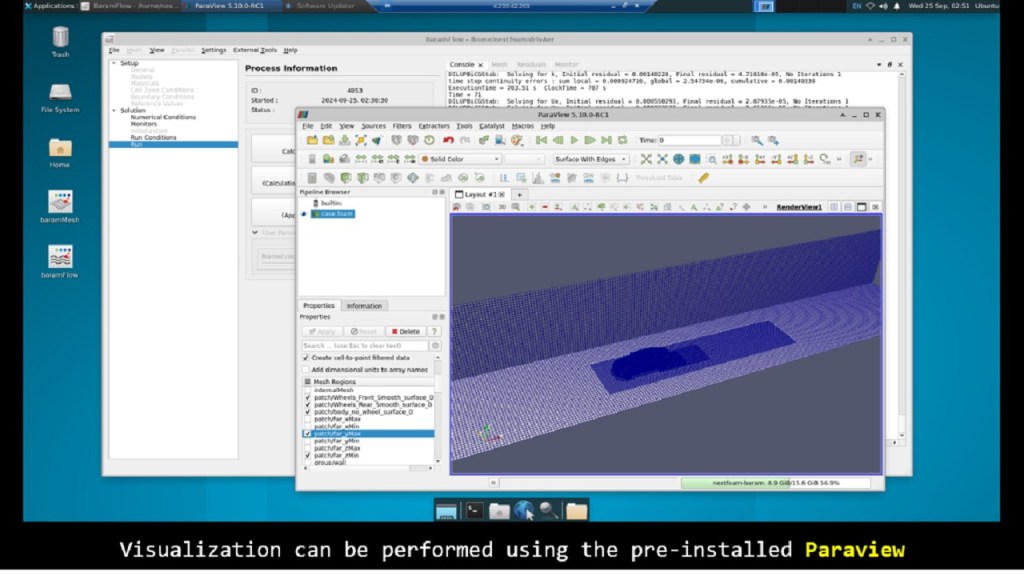
We use open source codes (BARAM, NextFOAM) that we have developed ourselves, and if you wish, we can provide you with the source code used in the simulations and train you on how to use it. This enables our customers to perform their own simulations in various situations even after the end of the consulting contract.

Automate CFD Simulation Process & Develop Dedicated Progra – DIY CFD
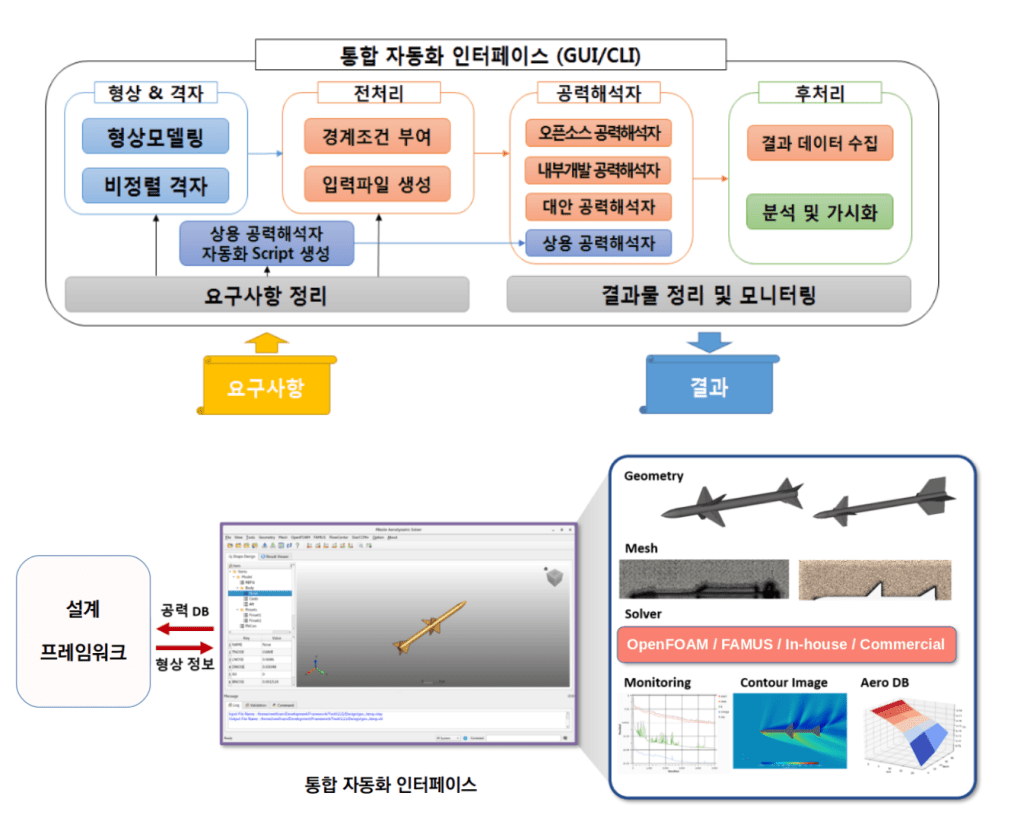
Do It Yourself (DIY) isn’t just for building furniture; it’s also for designing your own CFD processes.
In the past, CFD analysis was dominated by the use of a handful of general-purpose commercial programs, but today, many organizations have their own programs, such as KIMM-Flow, GSS, EagleCFD, ISAAC, and others. Having a dedicated program that is specific to your product or system has many advantages, including increased efficiency, cost savings, user expansion, and workflow innovation.
Standardization/automation of geometry and mesh generation, solver setup, and post-processing can save time, avoid human error, and ensure quality of results. Most importantly, the analysis can be performed directly by non-CFD design and development staff. The design and development process becomes much more efficient, and researchers can focus on new research.
DIY programs are not limited in number of users, number of CPUs, or cost, so they can maximize the efficiency of the analysis process.
Development is done in collaboration with the customer at each stage: [solver development and validation] – [mesh system/numerical methods/post-processing standardization] – [process automation] – [UX development] – [testing and refinement] – [training].
The interface is not limited to a CFD program, but can also be developed as an interface to integrate design/optimization frameworks, different types of analysis programs, etc.
Real Time Simulator Development with AI/Data mining
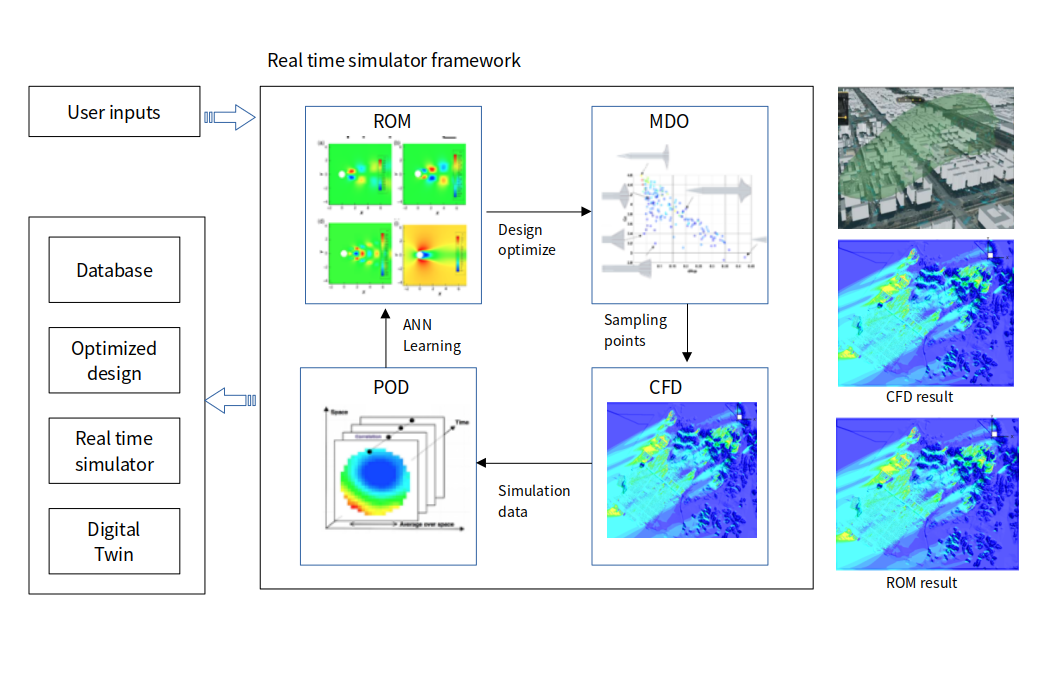
Provides a real-time simulator that uses data mining and artificial intelligence techniques for repetitive CFD analysis problems to instantly predict the results of unanalyzed conditions.
Using the analysis data under sample conditions, the basis functions are extracted using the POD method and a reduced-order model (ROM) is created using an artificial neural network-based extrapolation method. The reduced model can be used to predict and visualize high-precision data for new geometries and flow conditions in seconds.
It is the optimal solution for problems that require a lot of computing power and long computation times, such as simulation-based digital twins, multi-objective geometry optimization, database building, and multiphysics simulation.
The entire process of CFD code for data generation and flow field reconstruction and visualization uses open-source code, providing a license-free and efficiently upgradeable solution.
Development a Measurement System by Optical Images

Imaging technology is a technology that can measure the three-dimensional position and even the three-dimensional posture of a target using an optical camera, and it can be utilized in all fields that want to perform non-contact measurement.
In general, imaging technology using optical cameras focuses only on relative position measurement, and it is often impossible to analyze motion components such as other state information (ex. attitude, velocity, angular velocity). However, we combine imaging technology with state estimation filter technology to enable 6-degree-of-freedom motion component analysis at the same time.
In the case of 3D surveying technology, stereo cameras, i.e. two or more cameras, are usually used to perform 3D surveying simultaneously. However, we have three-dimensional imaging technology using monocular cameras (one camera).
HPC/Cloud Consulting
CFD often requires high performance computing (HPC) equipment due to the large amount of calculations. When building a computational cluster, we will recommend the optimal system based on the size of the problem, current computing equipment development trends, price fluctuations, etc.
When you want to use CFD simulation in the cloud, you will face various difficulties such as which cloud to use, how to configure the system in the cloud, and how to install the analysis code. We will suggest the best solutions to these problems.
Key Areas of Consulting Practice
| Aerospace | Aerodynamic DB of aircraft and missile, Store separation, Armory acoustic loading, Space launcher exhaust plume, Launch pad flame inlet, Turbopump, Rocket separation, Supersonic inlet ductt, Grid fins |
| Automotive /Train | Head lamp, Radiator, HVAC, Deicing/Defrosting, Drag, Crosss wind, Crossing of trains, Train wind, Micro pressure wave, Shape optimization, Icing, Hypertube, Screen door pressure, Tunnel fire, Battery cooling |
| Shipbuilding /Marine | Resistance, Self-propulsion, Energy saving device, Propeller performance/cavitation, Sloshing, Flue gas dispersion, Factory ventilation, Piping system, Wave generation, Riser, FPSO, Incidence analysis |
| Architecture /Civil | Building wind pressure, Wind environment, Stack effect, Bridges, Dam Spillways, Rainwater Tunnels, Ventilation |
| Electrical /Electronics | Cleanrooms, Transformers, Circuit breakers, Motors, Inverters, Dispensing, MLCCs, Refrigerators, Ovens, Air Conditioners, Coatings |
| Energy /Environment | Wind turbines, Solar power, Tidal power, Boilers, Engines, PPS, HRSG, SCR, Scrubbers, Dryers |
| Etc | Water Treatment Plant, Mixers, Heat Exchangers, Fans, Compressors, Turbines, Pumps, Hot Water Rolls, Fire |