AeroDB Framework
Framework to Create Aerodynamic force Database
Product Overview
High-precision aerodynamic databases are essential in the development process of various moving objects such as aircraft, guided weapons, drones, UAM, submarines, and torpedoes. However, data acquisition through wind tunnel testing is highly limited, and CFD also faces challenges in utilization due to its enormous computational demands.
This product is an automated framework for constructing aerodynamic databases based on surrogate models. It enables the creation of aerodynamic databases based on Mach number, angle of attack, side slip angle, and fin deflection angle.
- The Needs for Surrogate model
When design variables increase under various conditions, conducting high-fidelity full factorial experiments or calculations becomes practically impossible. Therefore, surrogate modeling techniques offer a method to replace the actual model by modeling its response at a lower cost (in time and resources). When building an aerodynamic database, this approach (1) significantly reduces the cost required for construction and (2) can be utilized to derive aerodynamic characteristics for all continuous combinations of conditions beyond the experimental points.
- The Need for an Automation Framework
Building surrogate models requires multi-layered tasks including DoE (Design of Experiment)-based selection of analysis points, flow analysis, surrogate model generation, and validation. Integrating these disparate tasks into a single framework is essential to achieve efficiency and scalability. Streamlining CFD setup for the analysis of numerous extracted points is crucial, and automation technology can enhance computational efficiency by dynamically varying various design parameters.
This framework enables the construction of an aerodynamic database based on Mach number, angle of attack, side slip angle, and fin deflection angle.
Workflow of Framework
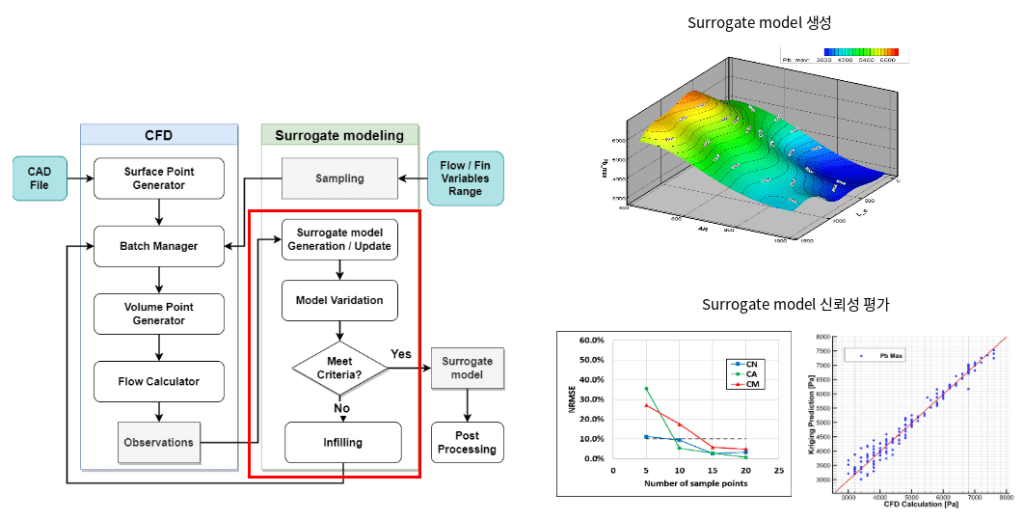
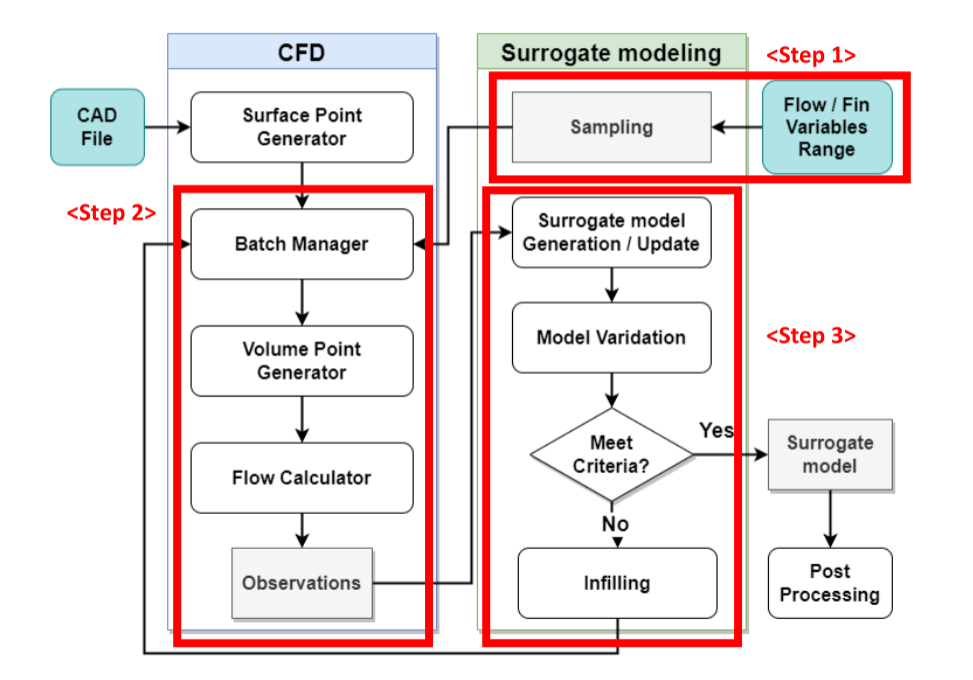
The framework proceeds in the following sequence: (1) experimental design-based sampling of analysis conditions, (2) flow analysis using CFD, (3) construction of a database based on surrogate models, and (4) post-processing.
DOE Sampling
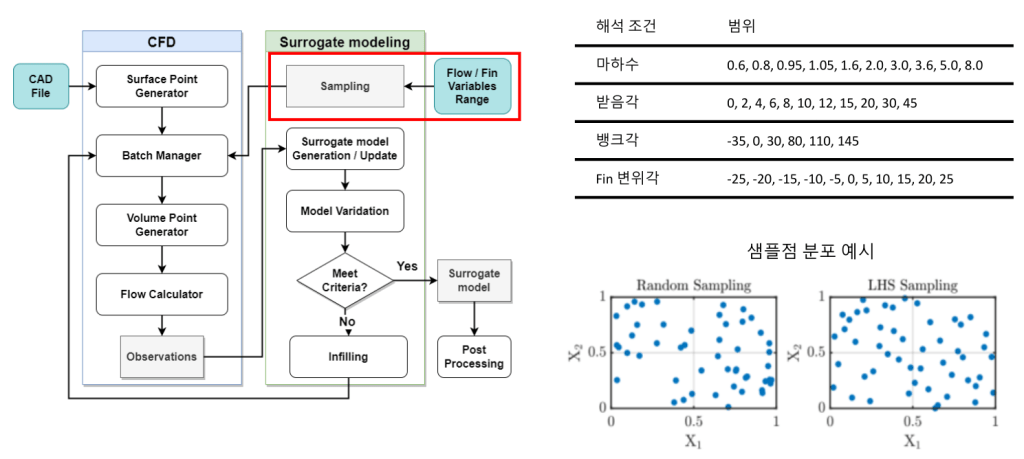
First, determine the sampling variables such as Mach number, angle of attack, side slip angle, and fin deflection angle. Define the range and properties for each variable, then sample to ensure analysis points are evenly distributed across the entire design space.
Various methods such as Latin Hypercube and Random can be used.
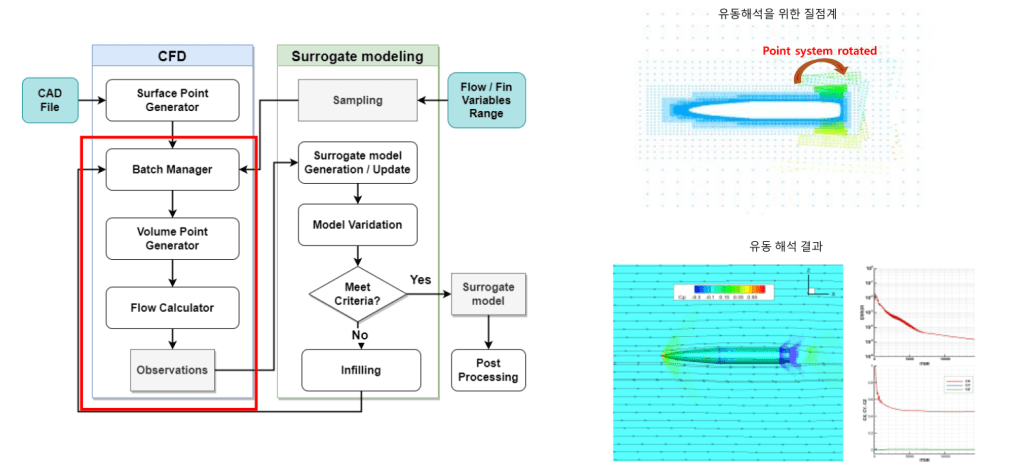
CFD Analysis via Batch Processing
Automatically generates analysis cases for sample points. Performs CFD analysis through batch processing and derives observation values for each element.
The CFD analysis code can utilize the meshless code FAMUS and the open-source code OpenFOAM (BARAM).
Surrogate Model Development and Reliability Assessment
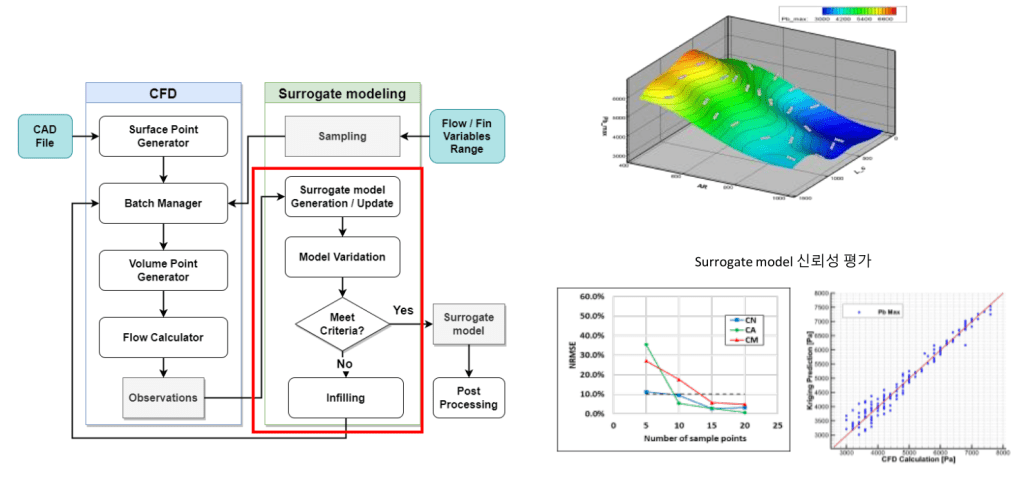
We build a surrogate model using the calculated result data. We evaluate the convergence of the surrogate model and derive the database model through singularity filtering and final accuracy assessment.
Aerodynamic force Database
Derive aerodynamic database configurations to ensure the accuracy and efficiency of the surrogate model. Perform random sampling-based sensitivity analysis and parametric studies for sensitivity analysis across the entire design space. Conduct relative evaluations of the influence of each design variable and identify patterns of aerodynamic coefficient variation based on design variables.
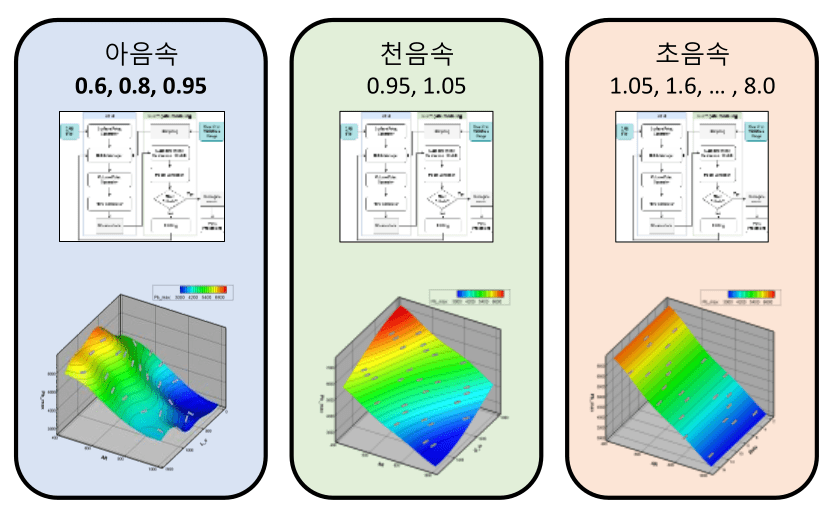
- Aerodynamic DB Partitioning: Construct the DB model by dividing into subsonic, transonic, and supersonic regions, and adjust the number of overlaps at boundaries.
- Sample Point Count Variation: Derive the optimal number by incrementally increasing the count.
- Outlier Filtering: Identify and filter outliers from cross-validation results.
- Adjust the DoE sampling parameter range to achieve uniform sample point distribution.
- Generate and validate the kriging model. Compare kriging predictions with CFD analysis values through cross-validation.

The Framework
The framework operates in the following sequence: (1) sampling, (2) simulation, (3) alternative model generation, and (4) post-processing and reliability assessment.

- Framework Structure
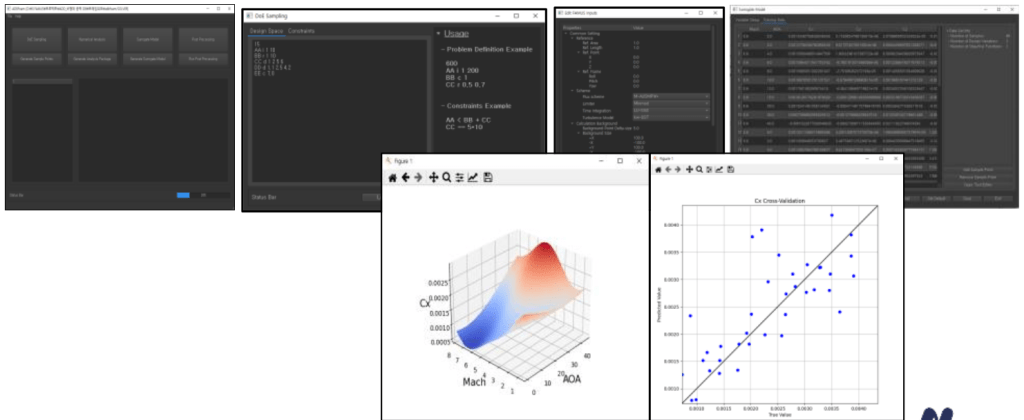
- Main Window: Consists of input edit button, run button, and output window
- DoE Sampling: Experimental parameter constraints, experimental parameter input
- Numerical Analysis: Generate batch run packages via bash scripts and FAMUS/Baram input
- Surrogate Model: Edit surrogate model parameters and training data, generate surrogate models using kriging methods
- Post-processing: Predict aerodynamic coefficients, generate response surfaces, perform cross-validation